Thursday, July 6, 2023

Visiting the homestead of Nathaniel T. Dodge

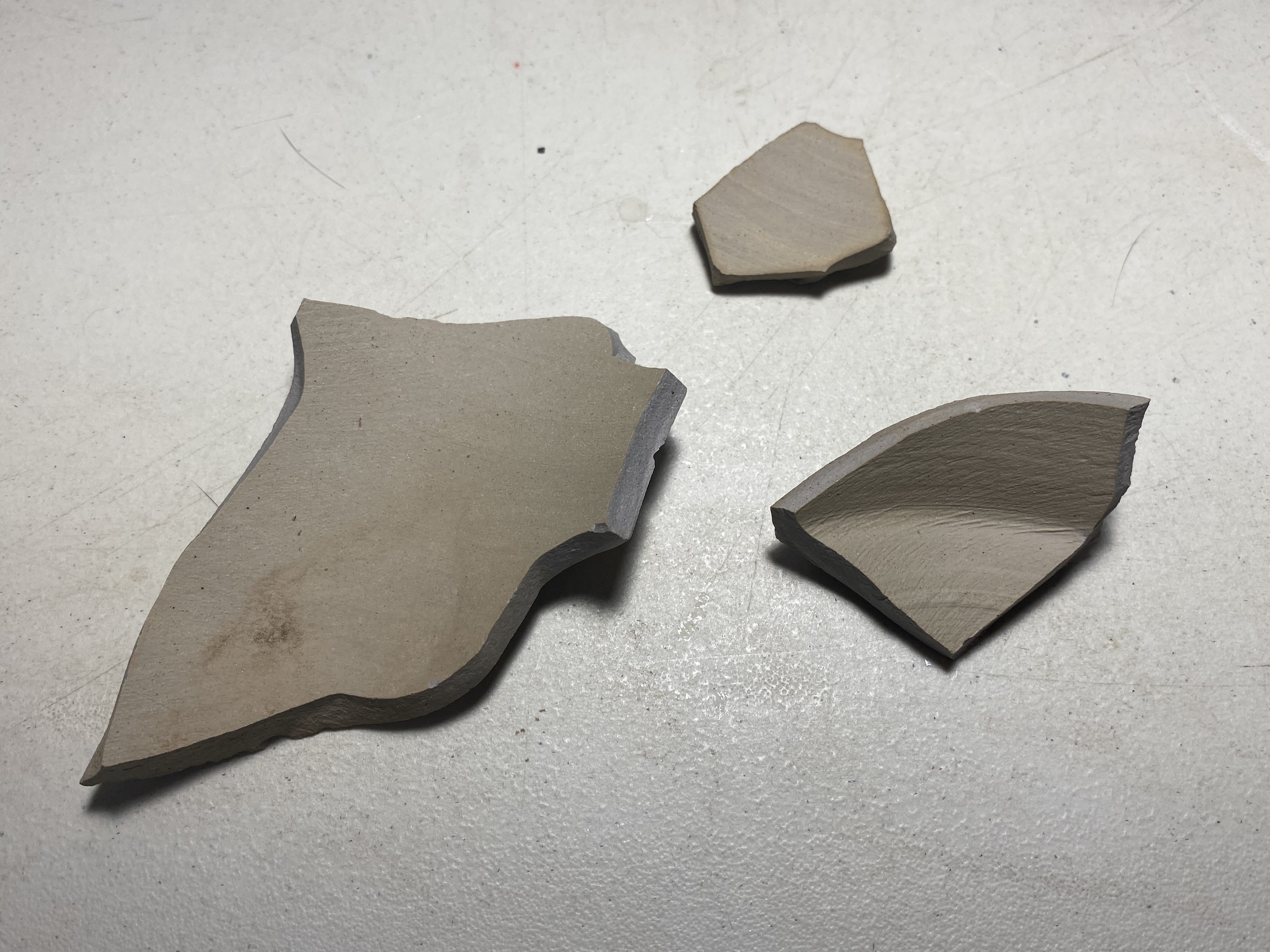
In April of 2021, I posted about the homestead of Nathaniel T. Dodge. In that post, I talked about the history of the homestead and the land changing hands throughout the years. I also talked about the Google Image dad found showing the foundation of the house that Nathaniel built. We decided that instead of going in 2022, we needed to go out there that Summer (2021), so we did. We reached out to the current landowners, and they were only too happy to have us over. When we got to the homestead, and specifically to the foundation of the house, we were overwhelmed by what we saw. There were shards of glass, pieces of pottery, chunks of brick, and a few remains of the wood that was used to build the house our ancestor lived in. We picked up what we could, took pictures and enjoyed our stay there.

Last month, we returned to the old homestead, and once again the current landowners were happy to have us over and let us look around. This time, we were more prepared for what was there. We found even more pieces of pottery, glass, nails, metal, wood, as well as four bricks that were completely intact. It is amazing to think about all of the objects that are still out there, as well as those that are now in our possession, that our ancestors used and handled in the course of their daily lives.

Below are a few pictures of what is left of the foundation of the house that Nathaniel built that we took on this most recent visit. When we were out there, we had a copy of the picture of the home with us, and were able to line up the house in the picture with the foundation that is still there today, and it is a spot-on match. He built his house down in a gulley, instead of on top of the gulley. There are a couple of reasons for this. One: he could keep his house out of the wind and snow in the wintertime. Two: it is possible this gulley was a small creek, and made sense to have his house next to a water source. Three: in building his house, he possibly wanted it close to the entrance of his land, and building his house here provided a place where could observe anyone who may be entering onto his land. 


This picture was taken in August of 2021

Below are pictures of some of the bricks, pottery, glass, metal and other items that we found between our trips in 2021 & 2023. These pictures were taken from our 2023 trip. We were so surprised by what we saw on our first trip to the homestead that we didn't take as many pictures as we should have.


The bricks were part of the foundation of the house and are more than 120 years old. The bag I used to carry all four of the bricks in was very heavy, much more so than carrying a bag of four modern-day bricks. There are other pieces of brick that are still there...and I'm sure others that are buried underground.


We decided to leave this wash pan at the homestead.


Below are additional pictures of many of the items that we found and brought home with us. Looking at the pieces we brought home from both trips, we found that a number of the pieces of pottery actually go together. In fact, some of the pieces fit together perfectly, and we were able to glue these together. Who knows how long these pieces have been sitting out on the ground, outside in the elements, broken apart.


Along with several pieces that fit together, there are other pieces of pottery, such as plates, cups, saucers and bowls that we found.


The mouth of a jug

This one is likely part of a plate that held a porcelain wash basin


I like seeing the moss on this piece. It definitely shows how long it has been outside

There were also several pieces of pottery that we found that had patterned designs on them. It is very likely that these pieces (as well as those above) were all manufactured in the 19th and early 20th Centuries. I'm surprised at the number of pieces of patterned wares we found.


This one is my favorite. The current landowners found this one shortly before our 2021 visit. They let me take this one. I currently have it framed.

There are also three pieces that have the makers mark on them. The first one we found in 2021, the other two we found in 2023. The first makers mark is K.T. & K. - China. This is Knowles, Taylor & Knowles, out of East Liverpool, Ohio. After looking online, we found this pottery manufacturer operated between 1854 and 1931. It is likely this first piece is a coffee or tea saucer. More information can be found here: http://www.laurelhollowpark.net/elo/ktk/ktk.html


The second piece is from Homer Laughlin - Premium Stone China. I found this one on our 2023 trip and was very surprised to find it. This particular makers mark was used between 1877 & 1900! For more info, please see: https://www.themuseumofceramics.com/gallery1


This last makers mark is from John Maddock and Sons in England. This makers mark dates to around 1906. For more info, please see: http://www.thepotteries.org/mark/m/maddock.html


We also found several broken bottle necks, all of which appear to date from the late 19th & early 20th Centuries.


Finally, we found several pieces of metal, from old nails to a belt buckle to harvesting blades to other metal items.


All in all, these two trips we took were very much worth the effort and time to go out there. We were able to make a connection to a time and place where our ancestors lived through the items that were left behind which we were able to recover. Again, thanks to the current landowners for allowing us the opportunity to visit the old homestead and bring home these items.

Sunday, June 18, 2023

Goodwin O'Grady (1893-1938); husband of Clara Belle (Dodge) Morgan

You never know where genealogy research will take you. In the 1931 Canada Census, I found that Clara Belle (Dodge) Morgan had remarried and was wedded to Goodwin O'Grady. Upon finding that Clara had remarried, I had a lot of questions, including: 'Who is Goodwin O'Grady?' 'When did they get married?' and 'Why did Clara retain her married name of Morgan instead of O'Grady in all the records I had already found for her post 1940?' In finding and researching Goodwin O'Grady, a door has been unlocked and an entire life discovered...as well as finding more pieces of the genealogical puzzle I didn't know were missing.

Who is Goodwin O'Grady? Goodwin O'Grady was born on July 20, 1893 in the District of Goleen, the Union of Skull, in County Cork, Ireland. He was the son of Carew O'Grady (1850-1919) & Mary Hingston (1862-1897). Below is his birth registration from 1893. He is on line #32.

1893 Birth Registration

In the 1901 and 1911 Census of Ireland, Goodwin is listed with his father. Each census record is recorded by family and attested to by the head of household. Below is the 1911 Census of Ireland, listing Goodwin and his father. There is no difference between the 1901 and 1911 Ireland Census form, other than the date of the Census.

1911 Ireland Census

On April 3, 1914, Goodwin boarded the ship S/S Ascania from Queenstown, Ireland to Halifax, Nova Scotia, arriving there on April 14, 1914. His arrival was actually recorded by United States Immigration, which had the responsibility to record alien arrivals from Europe who came through Nova Scotia. His entry information indicates that he is going to Winter, Saskatchewan. His brothers, Thomas & James O'Grady, had already immigrated to Canada. Below is the ship manifest and an extract of his entry into Canada via the United States. 

Ship Manifest for the S/S Ascania. He is the last entry on the manifest.

Manifest - Entry into Canada as recorded by the United States

It is important to note two things here. First, as Canada and Ireland were both part of the British Empire, no action was needed for him to obtain Canadian Citizenship, as he was already a subject of the British Crown. Second, his immigration to Canada was only a few months before Great Britain's entry into World War I, which would cost the lives some 49,000 Irishmen. Had he remained in Ireland, he very likely would have gone to war, with the real possibility of not coming out of that conflict alive.

Following his entry into Canada, he made his way to Winter, Saskatchewan, where he applied for a homestead in June 25, 1914. He obtained his first homestead patent in 1918. He later applied for, and obtained, a second homestead, which patent was issued in 1922. By this time, he homestead a total of 280 acres. During this time, Canada had conducted Census enumerations in 1916, 1921 & 1926. Goodwin is listed at Township 42, Range 25, West of the 3rd Meridian in both the 1916 & 1926 Census of the Canadian Prairies but is not found in the 1921 Canada Census.

When did they get married? In 1929, Goodwin married Mrs. Clara Belle Morgan. Clara had been separated from her first husband, William John Morgan, since 1923, following foreclosure of his homestead the year before. It was presumed that he had abandoned her and that his whereabouts were unknown. Clara & Goodwin are listed together in the 1931 Canada Census at Goodwin's homestead located at Township 42, Range 25, West of the 3rd Meridian. Also listed are Clara's daughter, Mary, son-in-law Clarence McNab, and grandson Wilbert McNab.

'Why did Clara retain her married name of Morgan instead of O'Grady in all the records I had already found for her post 1940?' Their marriage was short-lived. In 1935, it was found out that Clara's first husband was still alive and possibly living in Ontario. In searching through the available court records that are found on Family Search for the courts in Battleford and Wilkie, Clara never filed for divorce from her first husband. Goodwin filed for an annulment, which was granted on March 19, 1935. Below is a newspaper article which I found today documenting their marriage and annulment. 

Saskatoon Star-Phoenix: March 22, 1935

Goodwin O'Grady did not live long following his annulment. According to the book Blended Heritage, published by The Blended Heritage History Committee, Unity, Saskatchewan, Canada, in 1978, Goodwin met 'his untimely death on March 22nd, 1938. He was bucked off a bronc onto the frozen ground.' He is buried at the Woodlawn Cemetery in Neilburg, Saskatchewan.

I am in the process of obtaining additional records for Goodwin O'Grady, including the marriage and annulment records for Goodwin & Clara, as well as the death record for Goodwin. I will share these additional records once I receive them.

Friday, June 2, 2023

1931 Canada Census

On June 1, 1931, Canada conducted its Seventh Decennial Census, enumerating over 10 million people. Clara Belle Morgan (born Clara Belle Dodge) and her family were enumerated in this Census. In the last national census conducted in 1921, Clara, her husband William John Morgan, and their children William Hiram and Mary Anne, were found at Township 41, Range 18, West of the Third Meridian, near the town of Wilkie in Saskatchewan. In 1922, their homestead was foreclosed for failure to pay back a mortgage that had been taken out several years earlier, in 1917. William John Morgan left Saskatchewan at that time, leaving Clara and their children in Saskatchewan. He went back to Ontario, where he ended up living out the rest of is life.

Canada conducted a special Census in 1926 of the Prairie Provinces. Clara, along with her daughter Mary, are listed at Township 40, Range 16, West of the Third Meridian, near the town of Red Pheasant. Clara was listed as a lodger at the residence of Arthur Amor, and her daughter Mary was listed as a Domestic. I was unable to locate her son, William Hiram Morgan, in the 1926 Canada Census.

In 1911, Clara had immigrated to Canada with her family, while her siblings remaining in the United States. 20 years later, in 1931, her siblings were found in Colorado, Wyoming and California, as follows:

- John Edward Dodge: Fairplay, Colorado
- Rachel Elizabeth (Dodge) Newitt: Grand Junction, Colorado (She would move with her family to Tacoma, Washington at the end of 1931).
- Frances Cleveland (Dodge) Nemetzky: San Francisco, California (She married her second husband, David Nemetzky, in January of 1930; he was honorably discharged from the Army in January of 1931).
- Dwight Hector Dodge: Woodlake, California
- James Robert Dodge: Laramie, Wyoming
- Ann Hazel (Dodge) Graham: Colorado Springs, Colorado

Unlike the United States, which has a 72-year restriction on publicly releasing census records, there is a 92-year restriction on the public release of census records in Canada. Yesterday, the 1931 Canada Census was made public and is available on Ancestry. The Census, which is organized by enumeration district,  is available to search by image. The names in this census will be indexed using AI technology (much like the 1950 US Census was when it was released). 

Several years ago, I found her son, William Hiram Morgan, in the 1935 Canada Voting List in the locality of Winter (about 20 miles south of Neilburg) in western Saskatchewan. I decided to use the information from this voting list to search for Clara and her family in the 1931 Canadian Census. Looking through the images, and using information I had previously found, I found Clara, and her daughter, Mary, as well as her son-in-law Clarence McNab, and grandson Wilbert (spelled Wilber) McNab at Senlac Rural Municipality #411. However, I didn't find her son listed with them.

Clara and her family are located at Township 42, Range 25, West of the Third Meridian in this Census. Clara and her daughter were both born in the United States, and 1912 is the listed year of their immigration to Canada. Her son-in-law, Clarence McNab, and her grandson, Wilbert, were both born in the Northwest Territories. Wilbert is one year old, although his family have told be that registration of his birth was delayed by two years as they were living in a very remote location when he was born.

Each Canadian Census lists the national origin of each person enumerated. Clara and Mary were listed as Irish, while Clarence and Wilbert were listed as Scottish. Each Canadian Census also lists the religion of each person enumerated. Clarence, Mary and Wilbert were Anglican, while Clara was listed as an Adventist. Her parents were baptized in the Adventist Church when she was a young girl in Colorado.

The most surprising thing I found in this Census is that Clara had remarried. This is something that I never would have expected to come across, as all the later records of her (1940 and forward) all list her name as Clara Morgan. Her new husband's name is Goodwin O'Grady, and Clara is listed as Clara O'Grady. The Census indicates that they were married. Goodwin O'Grady was 37 years old, and Clara lists her age as 41 years old (she was 47 at the time of the 1931 Census, having been born in 1884).

From what I have found so far, Goodwin O'Grady was born in July of 1893 in Ireland, immigrated to Canada in 1914, and applied for and received a homestead. He is found at this location in the 1916 and 1926 Canadian Census (I didn't find him listed in the 1921 Canada Census). He passed away in 1938 (the exact date is unknown) and is buried at Woodlawn Cemetery in Neilburg, Saskatchewan. In looking at the 1935 Canada Voting List, Goodwin O'Grady is listed on the same voting list as William Hiram Morgan.

I am in the process of requesting a marriage record for Clara & Goodwin, as well as a death record for Goodwin, in addition to the homestead record. Once I have these records, I will share what I will have found. Once the indexing for the 1931 Census is completed, I will need to take the time to search the name index to locate Clara's family that I am still missing. Until then, please enjoy the image of the 1931 Canada Census I found of Clara, her husband, daughter, son-in-law & grandson.

1931 Canada Census

Saturday, March 4, 2023

Nathaniel T. Dodge - Buena Vista Reformatory Testimony

The Buena Vista Reformatory opened its doors in 1892. Its purpose was to reform juvenile offenders by having them work and learn different skills. From April to October of 1893, Nathaniel T. Dodge was employed at the Buena Vista Reformatory as the foreman over the brick makers. He was responsible for making sure that the inmates that worked under him were busy and working throughout the day. In his own words, 'I had charge of the men and showed them how to do the work, and I had to see that it was done properly.' As part of his duty during the day, he was to relieve the tower guard during lunch and guard the prisoners while the tower guard was at lunch. He stated that 'As a usual thing, as soon as I had eaten my dinner (lunch) I went on the tower to relieve the guard so that he might eat his.' He also did guard duty as a tower guard every other Sunday. He also did one night of guard duty as well.

In February of 1895, he, along with others who had worked at the Reformatory, certified to charges against the Deputy Warden of the Reformatory. The Rocky Mountain News from February 11, 1895 reported: 'The charges upon which the investigation is ordered were placed in the hands of the governor by a man named Garahty, a former guard of the reformatory. Witnesses called to substantiate the charges are Spencer, Van White and Gregg, former guards; Charles Robbie, a stone mason; Nathaniel Dodge, a brickmaker, and several inmates of the institution. It is charged that one of the officials has been guilty of extreme cruelty toward inmates; has acted in domineering and brutal manner toward prisoners, and at different times has made use of language which indicated he is not a fit man for the place. In addition to looking into his record, the committee will examine into the general management of the institution and will investigate charges that there has been a big rake-off in supplies furnished the reformatory. It is charged that the supplies have been ordered from one house in Buena Vista, and that such an individual as a storekeeper at the reformatory is unknown. It is claimed the supplies have never been checked up as they were delivered and prices were paid in excess of retail prices'. 

The investigation was conducted in February and March of 1895. The Rocky Mountain News from March 29, 1895 reported on the results of the investigation. These editions of The Rocky Mountain News are available on coloradohistoricnewspapers.org.

The results of the investigation confirmed the charges that were made. The investigation published their report and shared it with the Governor and the Colorado State Legislature. I found a copy of the report online. A copy of the published report I have saved is available here:

https://drive.google.com/file/d/1_cdO0B1u0SZY0gUSInkDQt4XctVGBosm/view?usp=sharing

As part of this investigation, Nathaniel was deposed and provided testimony to what he witnessed and knew about the Reformatory. I recently obtained a copy of his testimony from the Colorado State Archives, a copy of which is available here:

https://drive.google.com/file/d/1bTxZrBK6NK4msjBqFOfLzAWY6Y9Lg1WJ/view?usp=sharing

Not only does he testify to the goings on that he witnessed and knew about at the Reformatory, it also provides an additional snapshot of his life during that time as well as provides additional details on his life. I won't go into the details of the investigation that he testified to while at the Reformatory. However, I will look at the details of his personal life that he shared while giving his testimony during this investigation.

Nathaniel gave his testimony on March 18, 1895, at the Office of the State Board of Charities and Corrections in Denver. At the time of giving his testimony, he stated that he was living 'about two miles from Buena Vista', and that he had lived there 'a little over a year.' He further explained that he was working as a Ranchman, but that he did not own the ranch he was living on. He explained that 'I own a piece of land but do not live on it at present.' He is referring to the homestead that he had purchased in April of 1894, located nearly two miles northwest of Buena Vista. Due to extenuating circumstances, he was not able to move on to the homestead he had purchased until October of 1895, as he did not have the means to construct a home for his family to live in. He also explained that he had lived in Chaffee County for 'A little over 15 years' (he left Maine for Buena Vista in February of 1880), and that he had primarily been a rancher during that time. 

He worked at the Reformatory from April 5, 1893 until October 6, 1893. As stated above, he was the foreman for the brick yard. He also did guard duty while he worked there. When asked if he was a practical brick maker, he stated that: 'I have worked at the business ten seasons.' When he started as a brick maker at the Reformatory, he 'had a convict who was a practical brick maker' working with him. He explained that he had two of the inmates to help with the brick kiln. He explained that 'I had to be awake night and day too as burning brick is very particular work.' The inmate who was a brick maker was taken away by the Deputy Warden and replaced by an individual (not a convict) to run the kiln during the night. He explained that this individual 'The first night he run it (the kiln) he melted down two tiers, the second night he melted down the center of the kiln.'

He also testified to his knowledge of basic construction. In addition to being 'a practical brick maker', he explained that 'in [the] Eastern States [I] have done a good deal in the building line.' Before coming to Colorado, he had worked at a lumber mill in Gardiner, Maine. Besides sawing lumber and preparing it for practical use, it isn't known what all that job involved. He was asked why two of the doors in the recently constructed cell house wouldn't close. These doors 'which had been hung on their hinges, would not shut because they were not true.' He explained that 'in setting the frames up and laying the stones into them, the foreman did not see to it as he ought, and this the iron facings got sprung.' When asked what would need to be done to fix them, he explained that he would need to examine them before answering that particular question. No doubt his experience in building would prove vital in later building the house for his family on the homestead he had purchased.

I will touch lightly on the testimony he gave as to the goings on at the Reformatory. He had served as Justice of the Peace in Buena Vista during the 1880's, so he was familiar with the administration of the law. I get the sense that what he testified to were things he did not expect to have witnessed, experienced or heard of while working at the Reformatory and that he was not only relieved to be done working there, but also relieved to share his testimony with those who would listen. Following the investigation, changes were recommended, regulations implemented, and improvements were made. However, there is no evidence that he went back to work at the Reformatory.

Saturday, February 18, 2023

On this date...February 17, 1880

February 17 - On this date 143 years ago, Nathaniel T. Dodge and family left their home on South Gardiner, Maine and moved to Buena Vista, Colorado. There are two newspaper articles that pinpoint the exact date Nathaniel and his family left Maine. They are The Kennebec Reporter from February 14, 1880, and The Gardiner Home Journal from February 18, 1880. 

The Kennebec Reporter (Saturday, February 14, 1880) reads: 'Mr. N.T. Dodge and his family with Mr. Jacob Host will leave here next Tuesday for Buena Vista, Col., where they expect to give their whole attention to farming. Mr. Host’s family will remain here for the present. They will carry with them the best wishes of many acquaintances and friends, and may the time be not far distant when we may hear of their prosperity, and learn that fortune has crowned their efforts.'

The Gardiner Home Journal (Wednesday, February 18, 1880) reads: 'N.T. Dodge and family left So. Gardiner, yesterday, for Buena Vista, Colo. Mr. Jacob Host accompanies them.'

Prior to moving to Buena Vista, Colorado, Nathaniel had been living in Gardiner, Maine with his wife, Fannie, and their two young sons, Sherman and Alfred. Nathaniel had been working at a sawmill in Gardiner with his brothers, Curtis & Asa Dodge, during his time in Gardiner. Prior to 1880, two of his sisters, Mary, and her husband, Ezekiel Bray, and Sarah, and her husband, Benjamin Bray (Ezekiel and Benjamin were brothers), had already left Maine and settled in Buena Vista. They had arrived in Colorado during the early 1870's and were involved in farming, ranching and mining. Perhaps they had convinced Nathaniel to come West for a better opportunity than just being a Maine mill laborer.

So, nearly fifteen years after the Civil War and just over a decade since the completion of the Transcontinental Railroad, Nathaniel and his family left Maine for Colorado. Nathaniel’s parents had both passed away just a few years earlier. Fannie’s parents were still alive and living in Pittston (just across the Kennebec River from Gardiner), but were in failing health. Her father, John B. Stevens, sacrificed his health while serving in the Civil War. He would pass away in 1884. Her mother, Eliza Ann Butland, would pass away in 1889. Had they been in good health, I believe they would have joined their daughter and son-in-law in the journey to Colorado.

The cross-country trip would have been by rail and would have probably taken seven to ten days to travel from Gardiner, Maine to Buena Vista, Colorado. I don’t know the route they would have traveled (as train passenger records are not available), but it likely they would have traveled through Portland, Maine; Boston; New York; Philadelphia; Pittsburgh; Columbus; Cincinnati; Louisville; St. Louis; Kansas City and Denver before probably taking a stage to Buena Vista, or taking the first rail line to Buena Vista, which opened in March of 1880.

Two years later, Nathaniel, Mary and Sarah would be joined by their brother, Curtis Dodge, in Colorado. The Kennebec Reporter from March 4, 1882 (Saturday) reads: ‘Mr. Curtis Dodge and Jacob Host leave Monday for Colorado, where they will seek their fortune and we hope will be successful.’ In January of 1883, Curtis signed as a witness for a Mining Deed between Benjamin and Sarah Bray. Curtis Dodge's stay in Colorado was short-lived. The Kennebec Reporter from January 5, 1884 (Saturday) reads: ‘Curtis Dodge, who has been absent in Colorado about one year and a half, arrived home on Wednesday of last week.' Curtis spent the remainder of his life in Massachusetts and Maine.

Nathaniel and Fannie remained in Buena Vista, along with his sisters and their families. Nathaniel was involved in local politics and was elected as Justice of the Peace during the 1880's as well as in 1906 and in 1924. He owned a 40-acre homestead just a few miles west of Buena Vista and farmed and ranched there. Eight more children were born to Nathaniel and Fannie after they settled in Buena Vista: John Edward; Clara Belle; Rachel Elizabeth; Frances Cleveland; Dwight Hector; James Robert; Ann Hazel & Mildred. They endured the loss of two of their children; Mildred, who passed away as a young girl during the early 1900's, and Alfred, who disappeared in March of 1902 while working as a stage driver at St. Elmo and was never found. Each of their surviving children eventually left Buena Vista to pursue their lives and fortunes away from home.

Fannie passed away at the family home in Buena Vista in May of 1919. Nathaniel passed away at the Rio Grande Hospital in Salida in April of 1926. They were both buried at Mt. Olivet Cemetery in Buena Vista. Placer stones had been placed around Fannie's grave following her death and burial. However, their graves remained without a gravestone until 2009, when their descendants purchased a gravestone and had it placed at their gravesite.